

Séminaire : Vertical cloud overlap and RadForcE : a Monte Carlo line-by-line longwave model – R. Lebrun
27 novembre @ 10h30 – 11h30 CET
Lien visio : https://visio.numerique.gouv.fr/pby-ezyb-ugc
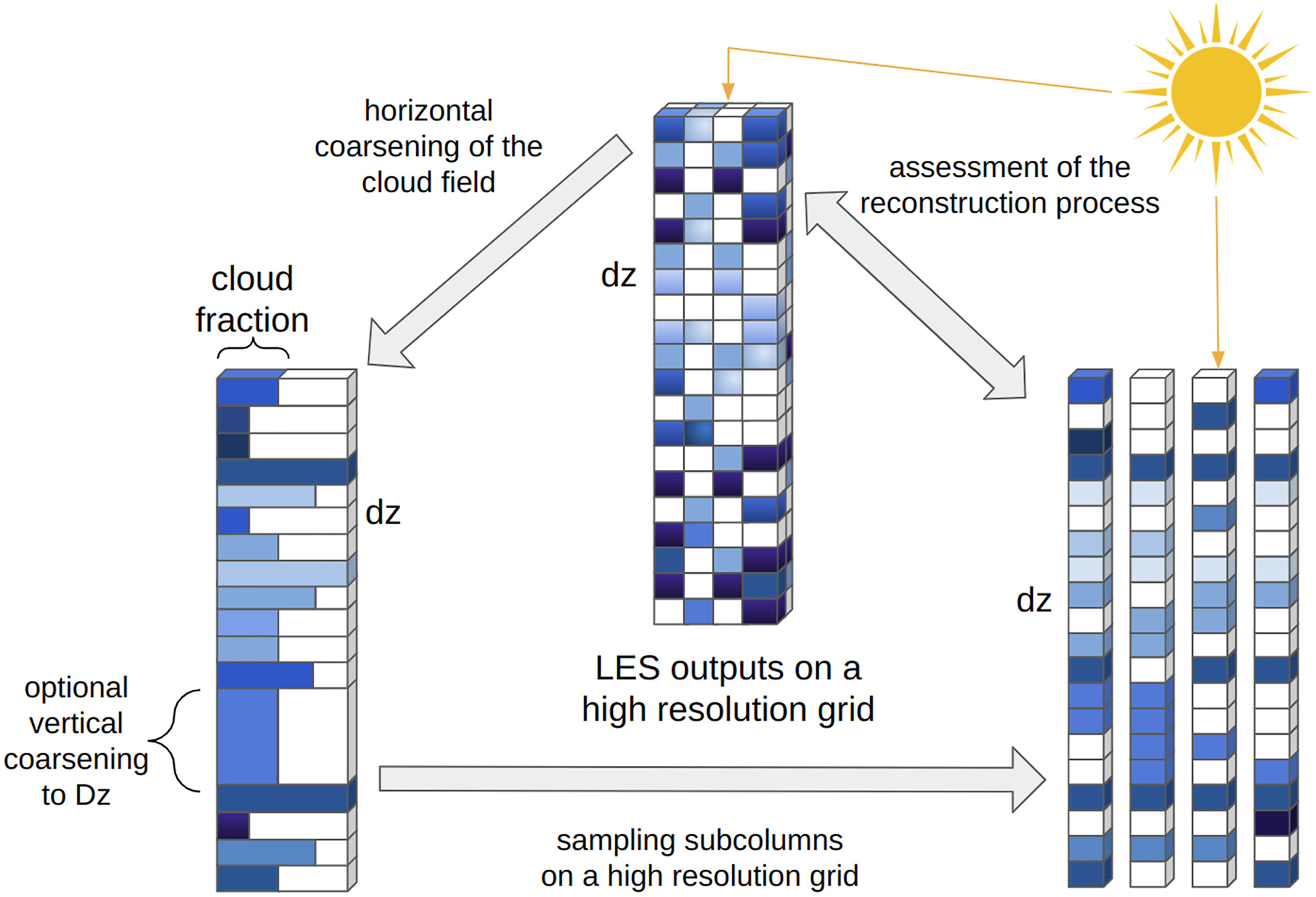
Cloud-radiation interaction is a crucial component of the atmosphere’s energy budget, and it has been shown that it represents one of the most important obstacles to the improvement of global climate models. In this work, we focus on one of the key aspects in the representation of the effect of clouds on radiation : vertical cloud overlap. This notion is indeed directly linked to the cloud cover, which is a quantity of first order importance in the calculation of the albedo of a cloud scene.
Within the framework of the vertical cloud overlap, we develop a formalism allowing us to explore in depth various hypotheses of cloud overlap, in particular exponential-random overlap. We show that the vertical subgrid variability of the cloud fraction, although not taken into account by large-scale atmospheric models, can have a significant impact on the solar fluxes calculated at the top of the atmosphere.
We then focus on incorporating these overlap results into a Monte Carlo radiative transfer model (RadForcE), where vertical overlap is sampled ‘on the fly’ along radiative paths. We present this line-by-line longwave model, and show how it allows us to compute the outgoing longwave radiation at the top of the atmosphere from ERA5 profiles for a 10-year period, at a small computational cost. We this new method we are also able to directly compute the individual radiative forcing of greenhouse gases, present estimates of the radiative forcing for a doubling of CO2, as well as visualize the altitude emission profiles of greenhouse gases.
Pour en savoir plus :
- Lebrun, R., Dufresne, J.-L., & Villefranque, N. (2023). A consistent representation of cloud overlap and cloud subgrid vertical heterogeneity. Journal of Advances in Modeling Earth Systems, 15, e2022MS003592. https://doi.org/10.1029/2022MS003592